Where Are The Free Views In Florence?
The free viewpoints of Florence explained: Piazzale Michelangelo, the Arno bridges, San Miniato al Monte, the Giardino delle Rose and the free cathedral nave, with what each one costs.
Florence is a city that can be looked at for nothing. The terraces, bridges, gardens and church naves that carry its famous views are, almost without exception, public spaces or places of worship with no ticket at the door. The paid attractions sit beside them, sometimes on the very same square, and the difference between the two is not always obvious from the street. This guide separates them, viewpoint by viewpoint, using only what the official pages publish, and it names the free walking tours that meet near them.
The short version: the skyline view is the Piazzale Michelangelo terrace, free and open at all times. Around it sit the Giardino delle Rose below and San Miniato al Monte above, both free. The Arno bridges, above all Ponte Santa Trinita, give the river angles. And the cathedral nave, the one interior view that costs nothing, is free Monday to Saturday. Everything else on these hills, the Forte di Belvedere and the Giardino Bardini above all, is paid.
Where Is The Best Free View Of Florence?
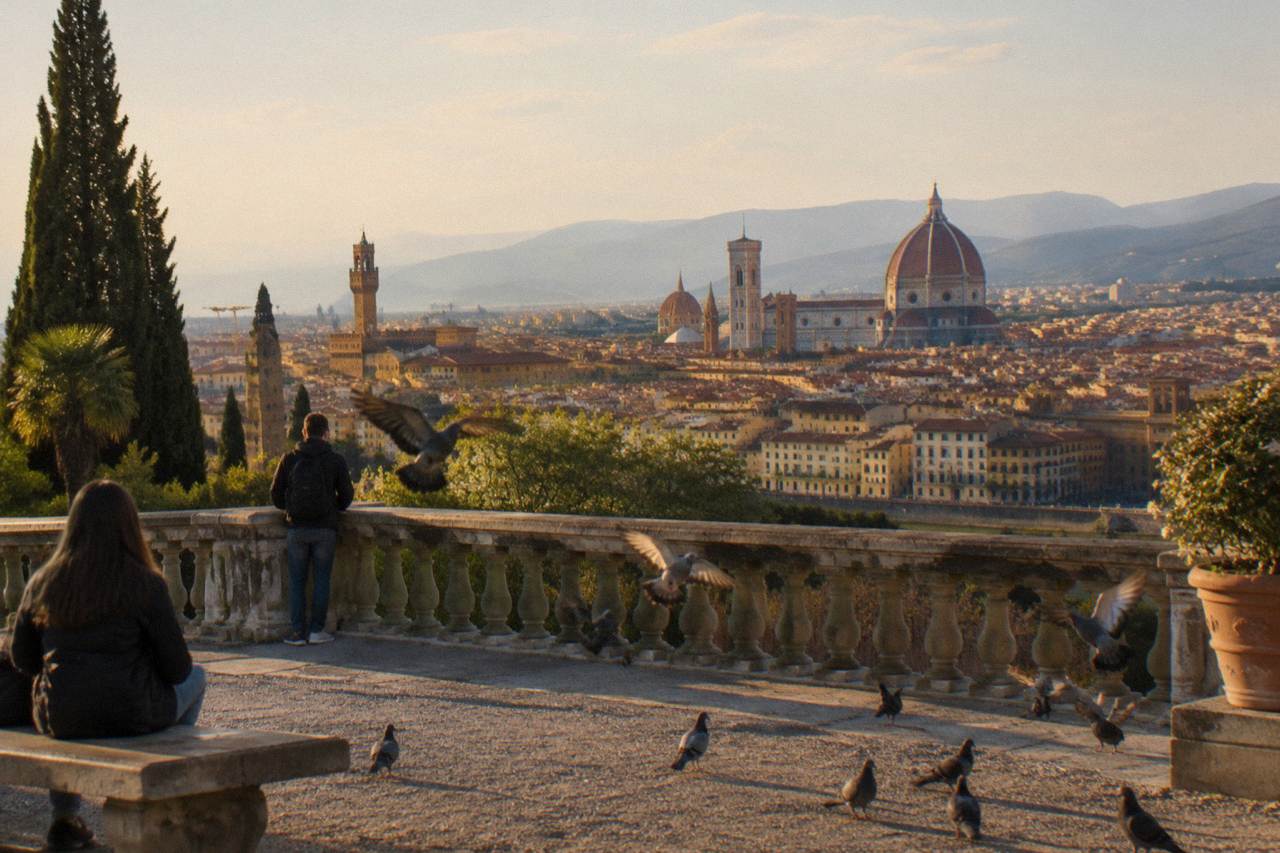
The Piazzale Michelangelo terrace is the free view of Florence: a public viewpoint above the Arno, owned by the Comune di Firenze, open at all times and costing nothing to stand on. The cafe and the parking on the hill are private or regulated and are not part of the viewpoint itself. No ticket, no booking and no seasonal closure applies to the terrace.
That is the whole rule, and it is worth being precise about it because the hill carries several different regimes. The terrace is public space. The cafe is not. The Forte di Belvedere, higher up the same hill, is a civic museum site that charges non-residents and closes in winter, and the Giardino Bardini across the valley is a paid garden run by its own foundation. None of that touches the terrace itself. A visitor who walks up, stands at the parapet and walks down has spent nothing.
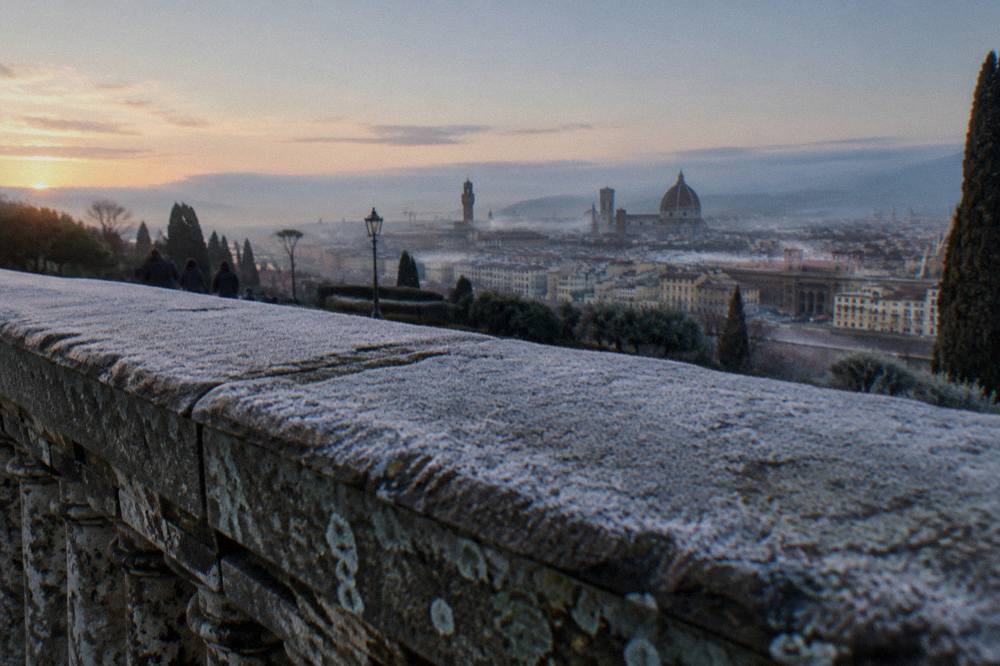
The hill also carries the city's calendar. On 24 June each year the Fochi, the fireworks of the Festa di San Giovanni, are fired from the hill of Piazzale Michelangelo at 22:00, and the Comune's own tourism page names the Lungarni along the Arno as the place to watch them from. The Calcio Storico final on 24 June takes place in Piazza Santa Croce. So the terrace is not just a viewpoint but the stage for the one evening a year when the whole city looks at the hill.
For visitors who would rather have the hill explained than simply stand on it, the free walking tour roster includes walks that meet in the neighbourhoods the climb passes through. The Evening Medici Art Walk, a pay what you want walk on GuruWalk rated 4.48 out of 5 across 73 GuruWalk reviews, meets at Piazza Santa Trinita on the river and runs in English for 1 hour 45 minutes. The site's guide to the terrace itself, Piazzale Michelangelo And The Free View, takes the hill in full detail.
Is Piazzale Michelangelo The Only Choice?
No. The free viewpoints of Florence include the Giardino delle Rose below the piazzale, the abbey of San Miniato al Monte above it, and the three walkable Arno bridges: Ponte Vecchio, Ponte Santa Trinita and Ponte alle Grazie, all free to cross at all times. Each is a separate public space with its own rule, and none of them needs a ticket.
The bridges deserve more attention than they usually get, because the Comune's own tourism page on the Arno crossings treats them as viewpoints in their own right. Ponte Vecchio is free to walk across at all times, and the shops on it are private. Ponte Santa Trinita is free to walk across and gives a direct angle on the Ponte Vecchio, which is also free to cross at any time. Ponte alle Grazie leads towards the San Niccolo quarter and the climb to Piazzale Michelangelo, so it works as the first leg of a free walking loop: cross at Santa Trinita, walk the Lungarni, cross back at alle Grazie and start the climb.
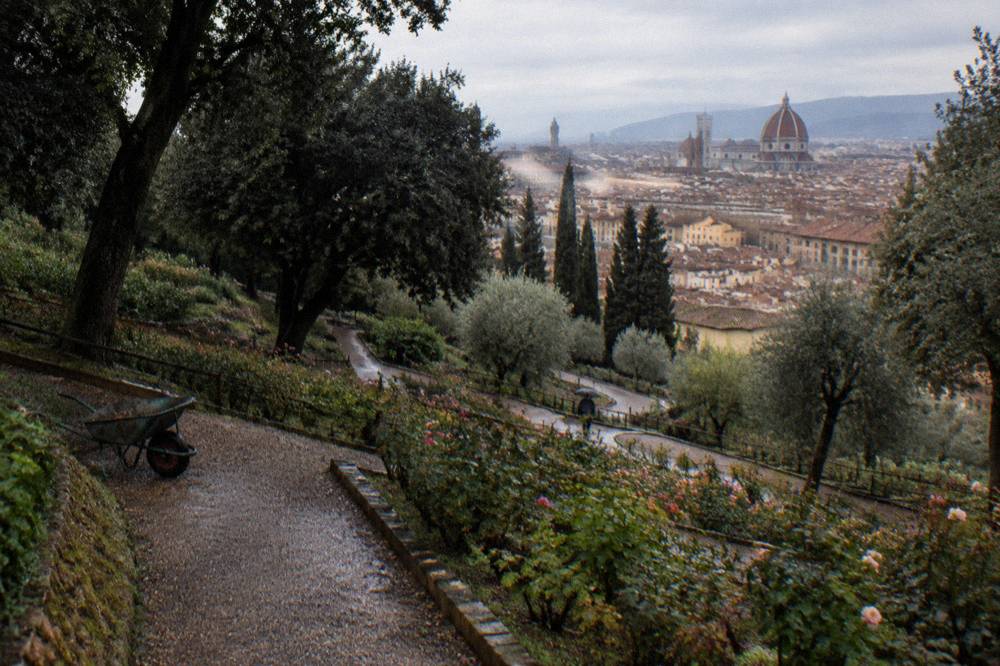
The two hill gardens and the abbey complete the set, and each has a different rule. The Giardino delle Rose is a free municipal garden below Piazzale Michelangelo, open all year with seasonal hours: 09:00 to 17:00 in January and February, 09:00 to 18:00 in March, longer in spring and summer. San Miniato al Monte above the terrace is free to enter with no booking for individuals or groups, open Monday to Saturday 09:30 to 13:00 and 15:30 to 19:00, Sunday 08:15 to 13:00 and 15:30 to 19:00, and not visitable during liturgical celebrations. The abbey's own page states it plainly: entry is free and no reservation is needed.
Here is how the free viewpoints stack up against each other, and what sits paid beside them:
| Viewpoint | Status | Rule | What stays paid beside it |
|---|---|---|---|
| Piazzale Michelangelo | Free | Public terrace, open at all times | Cafe and parking private or regulated |
| Giardino delle Rose | Free | Municipal garden, seasonal hours | Forte di Belvedere, EUR 8 non-residents, seasonal |
| San Miniato al Monte | Free | Abbey, no booking, closed during liturgy | Nothing at the abbey itself |
| Ponte Vecchio | Free | Public bridge, open at all times | Shops on the bridge are private |
| Ponte Santa Trinita | Free | Public bridge, open at all times | Nothing |
| Ponte alle Grazie | Free | Public bridge, open at all times | Nothing |
| Cathedral nave | Free | Monday to Saturday 10:15 to 15:45 | Dome, bell tower, baptistery, crypt, museum |
The pattern to notice is that the paid items cluster on the same hills and squares as the free ones. The Forte di Belvedere, open 24 June to 26 October 2026, Tuesday to Sunday 10:00 to 20:00, charges non-residents EUR 8 and is free only for residents of the Florence metropolitan area. Its loggia cafe is separately free to access. The Giardino Bardini is a paid garden run by the Villa Bardini foundation, free for residents of Florence, Arezzo and Grosseto, and it is not in the Ministry's first-Sunday scheme. A visitor who knows which side of each line they are standing on spends exactly what they intended to.
What Are The Quieter Viewpoints?
The honest answer is that no official source publishes crowd levels for any Florence viewpoint, so no viewpoint can be called quieter than another on published evidence. Alternatives to the terrace exist nearby: the Giardino delle Rose, San Miniato al Monte and Ponte Santa Trinita, each free, each a separate space, and each with its own opening rule.
That is a deliberately flat answer, and it matters. Articles about Florence routinely rank viewpoints by how busy they are, and those rankings are invented. The Comune publishes opening hours and ticket rules, not visitor counts. What can be said from the official pages is structural: the Giardino delle Rose is a garden with gates and seasonal hours, so it is not standing room at a parapet; San Miniato is an abbey that closes to visitors during liturgical celebrations; the bridges are public streets that cannot close at all. Those are real differences in the kind of space, not claims about how many people are in it.
San Miniato al Monte is the one that rewards the climb furthest beyond the terrace. The abbey sits above Piazzale Michelangelo, entry costs nothing, and the Sunday 17:30 mass is in Latin with Gregorian chant, which the abbey's own page publishes as part of its regular schedule. Visitors are not admitted during liturgical celebrations, so the free view of the interior comes with that condition attached. The site's full guide, San Miniato Al Monte, The Free Abbey Above Florence, covers the hours and the rules in detail.
The bridges are the other structural alternative. Ponte Santa Trinita gives a well-known angle on the Ponte Vecchio, and because it is a public bridge it carries no hours, no gates and no conditions at all. The Comune's page on the Arno crossings, One Bridge To The Next: Florence And Its River, is the source for all three free crossings named here. For anyone planning the walk itself rather than the view, pay what you want walks meet at both Piazza Santa Trinita and Piazza di Santa Maria Novella; the details are in the site's free walking tour guide.
Which View Works At Sunrise?
No official source publishes sunrise viewing conditions for any Florence viewpoint, so no honest answer can rank them. Piazzale Michelangelo and the three Arno bridges are public space with no hours, while the Giardino delle Rose and San Miniato al Monte open only from morning onward.
That is the whole of what can be said, and it is still useful. The terrace above the Arno is public space, open at all times, so an early arrival is a matter of the visitor's own schedule and nothing else. The bridges are the same: public streets, no gates, no published restrictions. The two hill gardens and the abbey are different in kind. The Giardino delle Rose keeps seasonal daytime hours, and San Miniato al Monte opens its doors at 09:30 on weekdays and 08:15 on Sundays. Neither can be an early-morning stop in any published sense.
One thing worth knowing about morning visits concerns the cathedral, not the hills. The nave of Santa Maria del Fiore is free Monday to Saturday from 10:15 to 15:45 and closed to visitors every Sunday, so the free interior view has a mid-morning opening and a mid-afternoon cutoff. Anyone building a day around free views should treat the nave as a late-morning stop and the open-all-times spaces as the flexible ones around it. A free walk through this part of Florence: Storyteller Walk, 2 Hours 15 Minutes.
Which View Works At Sunset?
Piazzale Michelangelo is a free public terrace above the Arno, open at all times, so it carries no closing time against a sunset visit. The Giardino delle Rose below it keeps seasonal hours that run longer in spring and summer, and the Arno bridges, including the Lungarni stretches the Comune names for the 24 June fireworks, are public space with no hours at all.
Sunset is also where the free walking tour roster has two walks built around the evening city. The Sunset Walking Tour, a pay what you want walk on freetour.com rated 9.1 out of 10 across 2,127 freetour.com reviews, meets at Piazza di Santa Maria Novella, runs for 2 hours in English, Italian and Spanish, and is the site's own related pick for this article. The Evening Medici Art Walk, on GuruWalk, meets at Piazza Santa Trinita and runs in English for 1 hour 45 minutes, rated 4.48 out of 5 across 73 GuruWalk reviews. Both are free to reserve with a tip to the guide at the end.
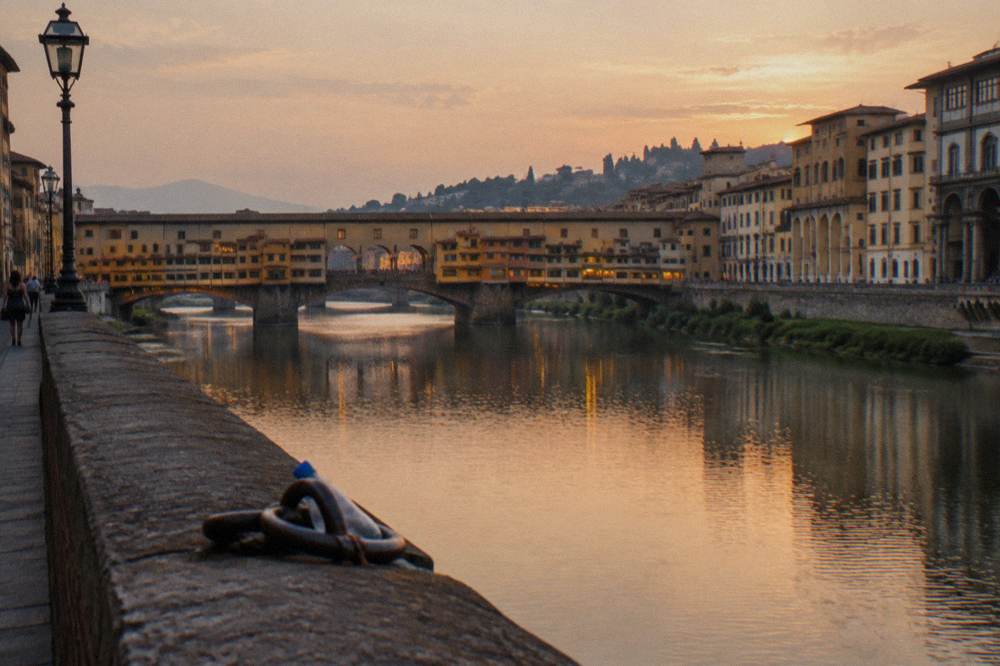
The Lungarni deserve their own mention in any sunset plan, and not only for the view. On 24 June the Fochi fireworks are fired from the Piazzale Michelangelo hill at 22:00, and the Comune's tourism page names the Lungarni along the Arno as the place to watch them, with the terrace itself as the launch site. On that one evening the free view is genuinely two-sided: the crowds on the hill watch the sky, and the crowds on the riverbank watch the hill. A paid private viewing spot on Lungarno della Zecca Vecchia also exists that night, which is worth knowing precisely so that nobody mistakes it for the only option.
For the rest of the year, the rules are simpler. The terrace is open at all times, the bridges are open at all times, and the Giardino delle Rose closes at a seasonal hour that runs later in spring and summer than the 17:00 of January and February. There is no published quiet hour for the viewpoints, so timing is a matter of luck.
Can You See The Dome For Free?
Yes, from two sides. The view of the dome from the public spaces around the cathedral, the streets and squares of the Duomo quarter, is free by nature. And the cathedral nave itself is free to enter, no ticket and no reservation, Monday to Saturday 10:15 to 15:45, closed to visitors every Sunday. The dome interior, the bell tower, the baptistery, the crypt and the museum are separate paid monuments and never inherit the nave's free status.
That split is the line the Opera di Santa Maria del Fiore draws firmly. The nave is free. Brunelleschi's Dome is paid, by timed reservation, via the Brunelleschi Pass only, and the dome slot applies to the first day of the pass. Giotto's Bell Tower needs a Giotto or Brunelleschi Pass, with no timed reservation required to climb it, only a pass inside its three-day validity. The Baptistery of San Giovanni needs a Ghiberti, Giotto or Brunelleschi Pass and is entered from the North Door. The Crypt of Santa Reparata and the Museo dell'Opera del Duomo are part of the same passes. The pass names and what each one opens are the stated facts here: Ghiberti, Giotto and Brunelleschi, each covering its own set of Duomo monuments. A free walk through this part of Florence: Duomo To Santa Croce Route Walk.
| Part of the Duomo complex | Status | Rule |
|---|---|---|
| Cathedral nave | Free | No ticket, no reservation, Monday to Saturday 10:15 to 15:45 |
| Brunelleschi's Dome | Paid | Timed reservation, Brunelleschi Pass, first day of the pass |
| Giotto's Bell Tower | Paid | Giotto or Brunelleschi Pass, no timed reservation |
| Baptistery of San Giovanni | Paid | Ghiberti, Giotto or Brunelleschi Pass, entry from the North Door |
| Crypt of Santa Reparata | Paid | Ghiberti, Giotto or Brunelleschi Pass |
| Museo dell'Opera del Duomo | Paid | Ghiberti, Giotto or Brunelleschi Pass |
Two fresh facts sharpen the picture for anyone visiting this year. Giotto's Bell Tower is undergoing the first full restoration in its history, a project the Opera di Santa Maria del Fiore dates from March 2026 with works running to about 2030, and the tower stays open to visitors throughout. In the Baptistery, the vault mosaics are not visible from the ground during a six-year restoration now in its third year, the first full restoration of the mosaics in over a century. Neither changes a price or a free status; both change what a visitor actually sees. One of the free walks goes through this part of the city: Art And Gastronomy Walk.
The Duomo quarter is also where one of the two freetour.com walks on this site's roster begins. The Duomo to Santa Croce Route Walk, run by Another Florence, meets at Piazza di Santa Maria Novella, runs for 2 hours 30 minutes in English, Spanish and French, and is rated 9.1 out of 10 across 3,361 freetour.com reviews. Like every walk in this site's roster of 24, 22 on GuruWalk and 2 on freetour.com, it is free to reserve and pay what you want at the end.
For walkers who want the Duomo quarter explained rather than just photographed, three more pay what you want GuruWalk walks meet at Piazza San Lorenzo, on the cathedral's side of the centre: the Storyteller Walk, 2 hours 15 minutes in English and Spanish, rated 4.73 out of 5 across 1,872 GuruWalk reviews; the Official-Guides History Walk, 2 hours in English and Spanish, rated 4.9 out of 5 across 470 GuruWalk reviews; and Chiara's Top Sights Walk, 2 hours in English and Spanish, rated 4.78 out of 5 across 275 GuruWalk reviews, on which entry tickets to the sights along the route are paid separately. This site, Free Things To Do In Florence, takes no booking and runs no walk itself; it points at the guides' own pages.
Common Questions About Free Views In Florence
Where Are The Free Views In Florence?
The free views are the Piazzale Michelangelo terrace, the Giardino delle Rose below it, San Miniato al Monte above it, the three free Arno bridges (Ponte Vecchio, Ponte Santa Trinita and Ponte alle Grazie) and the free nave of the cathedral. The Forte di Belvedere and the Giardino Bardini, on the same hills, are paid.
Where Is The Best Free View Of Florence?
The Piazzale Michelangelo terrace, a public viewpoint above the Arno owned by the Comune di Firenze, free and open at all times. The cafe and parking on the hill are private or regulated and are not part of the viewpoint.
Is Piazzale Michelangelo The Only Choice?
No. The Giardino delle Rose, San Miniato al Monte, Ponte Vecchio, Ponte Santa Trinita and Ponte alle Grazie are all free, each with its own opening rule. San Miniato is free with no booking and closes to visitors during liturgical celebrations.
What Are The Quieter Viewpoints?
No official source publishes crowd levels for any Florence viewpoint, so none can honestly be called quieter than another. The structural alternatives are the rose garden, the abbey and Ponte Santa Trinita, each a different kind of free space.
Which View Works At Sunset?
Piazzale Michelangelo is a public terrace above the Arno, free and open at all times, so no closing time applies. The Lungarni along the Arno are the spot the Comune names for the 24 June fireworks, which are fired from the hill at 22:00.
Can You See The Dome For Free?
Yes. The view of the dome from the surrounding public streets is free, and the cathedral nave is free to enter, no ticket, Monday to Saturday 10:15 to 15:45. The dome interior, bell tower, baptistery, crypt and museum are separate paid monuments needing a Brunelleschi, Giotto or Ghiberti Pass.