Duomo Florence: What Is Free And What Needs A Pass
The cathedral nave costs nothing to enter, no ticket and no reservation, Monday to Saturday from 10:15 to 15:45. Everything else in the complex, the dome, the bell tower, the baptistery, the crypt and the museum, sits behind one of three passes. This guide separates the two, and names the free walks that meet nearby.
Short answer
The nave of Florence Cathedral is free, no ticket and no reservation, Monday to Saturday 10:15 to 15:45, closed to visitors every Sunday and during religious celebrations. The dome, bell tower, baptistery, crypt and museum are paid and each needs a Brunelleschi, Giotto or Ghiberti Pass. The piazza outside is public space, free at all times.
The nave of Florence Cathedral, the Basilica di Santa Maria del Fiore, is free to enter: no ticket, no reservation, Monday to Saturday from 10:15 to 15:45. That single fact surprises many visitors, because the complex around the nave is a lattice of separate tickets, and the difference between the two is the difference between a free visit and a paid one. This guide on Free Things To Do In Florence sets out exactly where the free entry stops, which pass opens which monument, and which of the free, pay what you want walks meet in the streets around the piazza.
Is The Duomo Free To Enter?
Yes, the cathedral nave is free to enter, with no ticket and no reservation, and it stays that way every day it is open to visitors. The hours are Monday to Saturday from 10:15 to 15:45. The nave is closed to visitors every Sunday and during religious celebrations, a dress code applies as in any place of worship, and luggage and bags are not allowed inside. One of the free walks goes through this part of the city: Art And Gastronomy Walk.
The Opera di Santa Maria del Fiore, the body that runs the whole cathedral complex, states the rule plainly on its own pages: no ticket is required to enter the cathedral, and admission is always free. There is no suggested contribution, no timed slot and no queue-jumping fee for the nave itself. You arrive within the visiting hours, you pass the dress code and bag rules, and you walk in.
The conditions that do apply are worth knowing before you set out. The visiting window is not generous: 10:15 to 15:45, Monday to Saturday, means the nave is not open to sightseers in the early morning or the evening. On Sundays the building functions as a working church and visitors are not admitted, and the same applies whenever a religious celebration is under way. The dress code is the standard one for a place of worship, and the bag rule is strict: luggage and bags are not allowed, so travel light or plan a drop-off before you come.
One detail from the Opera's pages is easy to miss. Holders of Santa Reparata access, the crypt under the nave, can also visit the inside of the cathedral. That runs the usual direction of the rules: the paid parts of the complex carry their own access, and the free nave never inherits a charge from anything around it.
| Rule | What the Opera di Santa Maria del Fiore says |
|---|---|
| Ticket for the nave | None, admission is always free |
| Reservation | Not required for the nave |
| Visiting hours | Monday to Saturday, 10:15 to 15:45 |
| Sunday | Closed to visitors |
| Religious celebrations | Closed to visitors during them |
| Dress code | Applies, place of worship |
| Bags and luggage | Not allowed |
The trap is the assumption that "the Duomo is free" extends past the nave. It does not. The dome, the bell tower, the baptistery, the crypt and the museum are five separate paid entries under the same operator, and none of them inherits the nave's free status. The next section sets out which pass opens which of them.
Which Parts Of The Duomo Complex Need A Pass?
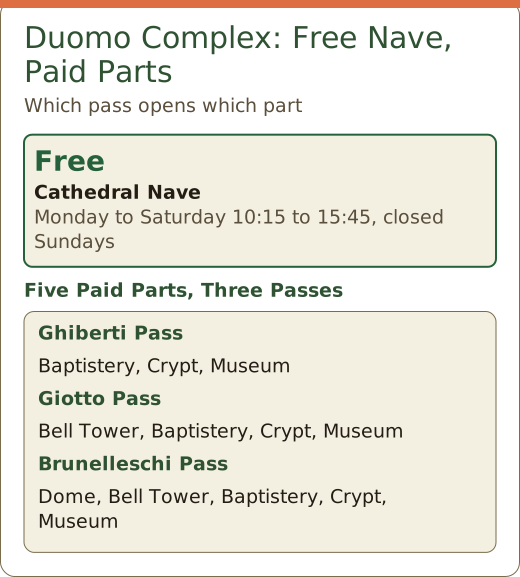
Five parts of the complex are paid, and each opens with one of three passes: the Brunelleschi Pass, the Giotto Pass or the Ghiberti Pass. The dome requires the Brunelleschi Pass with a timed reservation, and the dome slot applies to the first day of the pass. The bell tower takes a Giotto or Brunelleschi Pass with no timed reservation. The baptistery, the crypt and the museum each take one of the passes as set out below.
The Opera di Santa Maria del Fiore structures the complex around three passes, and the structure matters more than any single monument. The Brunelleschi Pass is the only one that opens the dome, and the dome is the only part that needs a timed reservation: the slot you book applies to the first day of the pass's validity. The bell tower works the other way, with no timed reservation at all; you need a Giotto or Brunelleschi Pass and you climb inside the pass's three-day validity. The official plan your visit page sets out the free nave against the pass monuments.
| Monument | Pass that opens it | Reservation rule |
|---|---|---|
| Cathedral nave | None, free | No ticket, no reservation |
| Brunelleschi's Dome | Brunelleschi Pass only | Timed reservation, dome slot on the pass's first day |
| Giotto's Bell Tower | Giotto or Brunelleschi Pass | No timed reservation, pass valid 3 calendar days |
| Baptistery of San Giovanni | Ghiberti, Giotto or Brunelleschi Pass | Entered from the North Door |
| Crypt of Santa Reparata | Ghiberti, Giotto or Brunelleschi Pass | Part of the pass |
| Museo dell'Opera del Duomo | Ghiberti, Giotto or Brunelleschi Pass | A separate museum from the cathedral |
No pass price appears in this guide, and that is deliberate. The Opera di Santa Maria del Fiore sets its pass prices on its own site, and no figure is published here. What can be stated firmly is the shape: three passes, three-day validity, one access per monument, and a dome slot locked to the first day.
The crypt and the museum are the two most often mistaken for free. The Crypt of Santa Reparata is the remains of the earlier cathedral under the nave, and it is paid, part of all three passes. The Museo dell'Opera del Duomo is a separate museum from the cathedral, also paid, also part of all three passes. Standing in the free nave, you are directly above one separate paid entry and around the corner from the other.
If you would rather have a local guide walk you through the neighbourhood than puzzle over passes alone, several free, pay what you want walks meet within the streets around the complex, and this site lists them all with their own pages.
What Can You See From The Piazza Without Paying?
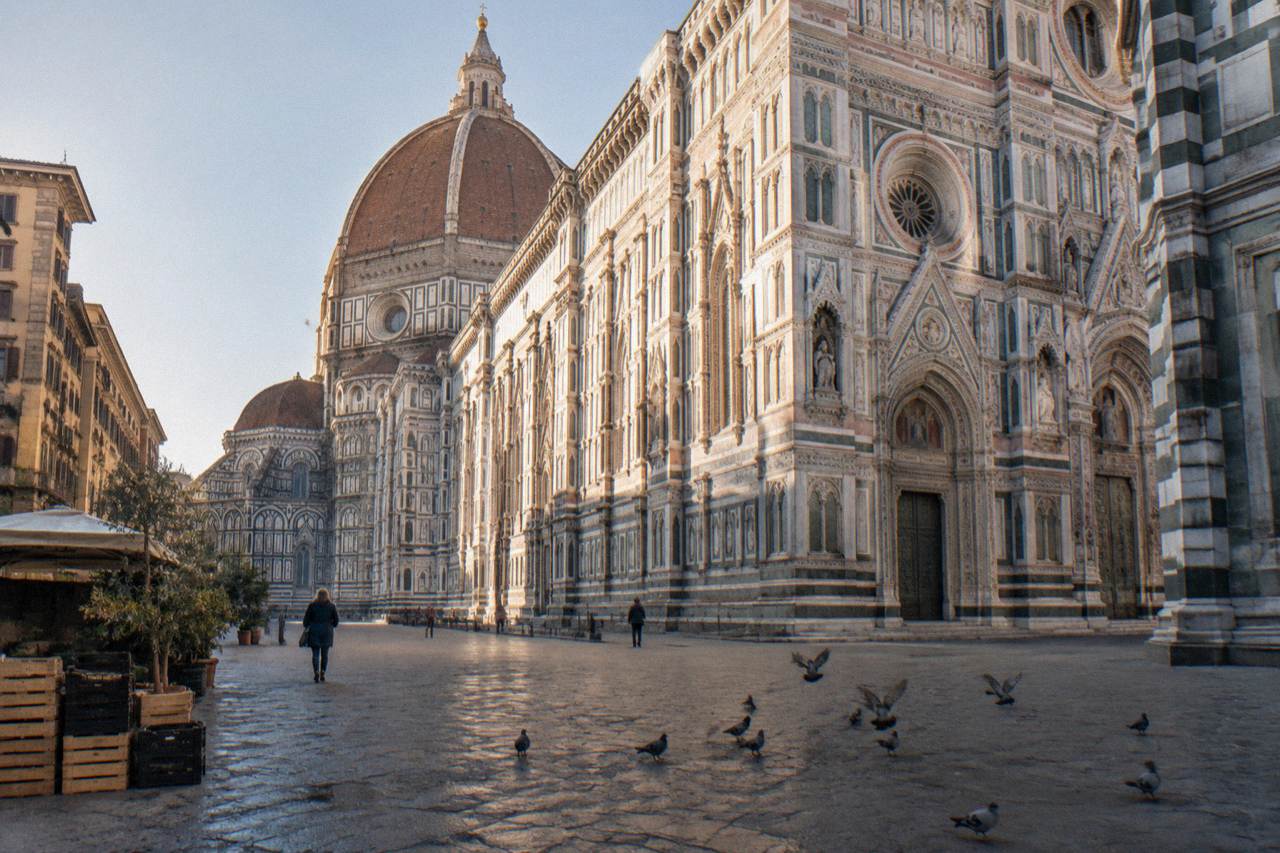
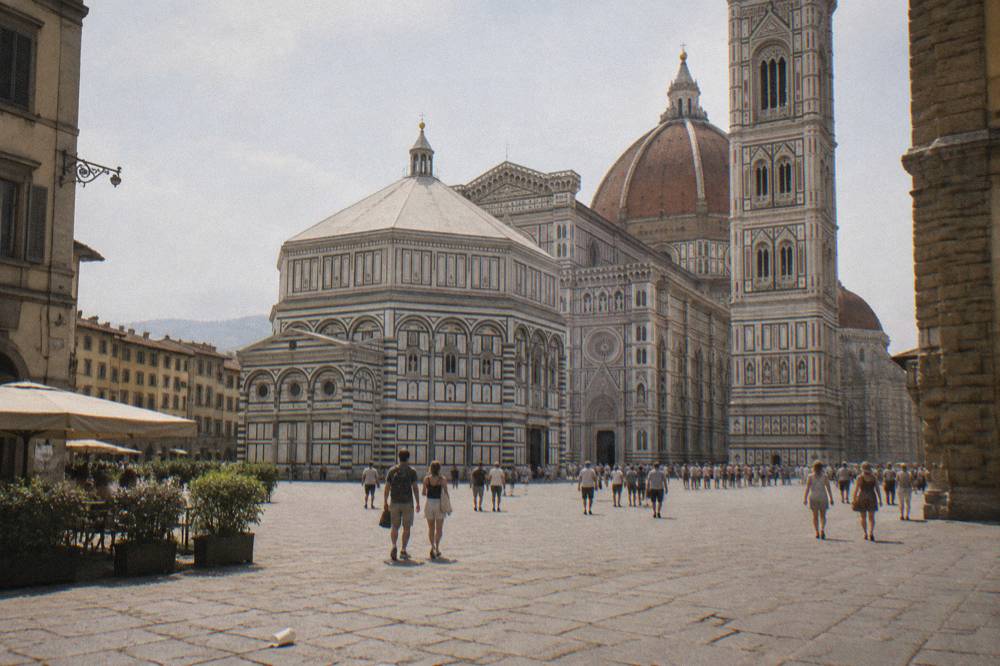
The piazza around the cathedral is public space, free to walk at any time, and it costs nothing to stand in it and take in the exterior of the complex. The nave inside is free within its Monday to Saturday hours. On Easter Sunday the piazza is also the stage for the Scoppio del Carro, the Explosion of the Cart, which is free to watch. The dome, bell tower, baptistery, crypt and museum remain paid from every angle.
The piazza does the work that a paid ticket does elsewhere. You can walk it at any hour, in any season, without a ticket, a pass or a booking. The cathedral exterior, the bell tower and the baptistery all face onto it, and the Opera's own visiting pages treat the piazza as the natural free counterpart to the paid interiors. Nothing about walking the square carries a charge, and nothing about the free nave changes that.
Once a year the piazza hosts a free event in the complex's calendar. The Scoppio del Carro, the Explosion of the Cart, takes place in Piazza del Duomo on Easter Sunday: a historic procession and a cart of fireworks, free to watch, with no ticket at all. The 2026 edition was held on 5 April. For an Easter visit, check the Comune's events page for the confirmed date.
The piazza also sits at the centre of the free-walk network. Among the walks listed on this site, the Duomo to Santa Croce Route Walk, listed on freetour.com and rated 9.1 out of 10 across 3,361 freetour.com reviews, meets at Piazza di Santa Maria Novella and runs 2 hours 30 minutes in English, Spanish and French. It is free to reserve and pay what you want at the end, like every walk on this site.
The walk's own page carries the full details, including its meeting point and its languages. For the piazza itself, the practical rule is simple: everything you do standing outside is free, and the moment a door takes you into the dome, the tower, the baptistery, the crypt or the museum, a pass is involved.
Why Are The Baptistery Mosaics Hidden Right Now?
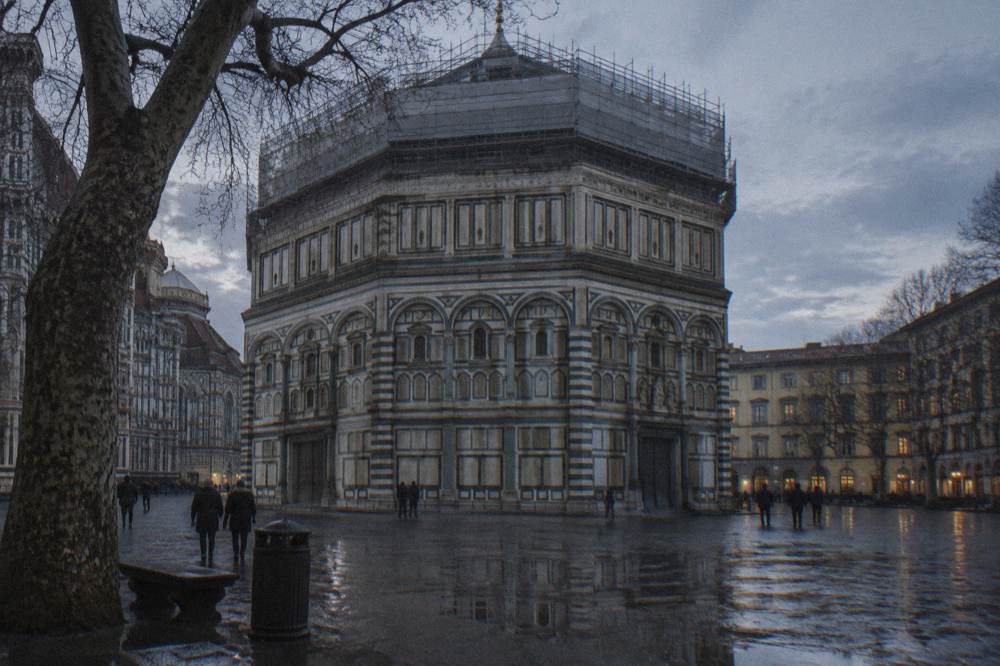
The vault mosaics inside the Baptistery of San Giovanni are not visible from the ground because they are under a six-year restoration, now in its third year, the first full restoration of the mosaics in over a century. The baptistery itself remains open and paid, entered from the North Door with a Ghiberti, Giotto or Brunelleschi Pass. The mosaics will not be visible from the ground for the next few years.
The restoration is the single most consequential fact about visiting the baptistery today. A six-year programme, currently in year three, means that a visitor walking in with a pass in late 2026 sees scaffolding and conservation work where the vault mosaics would normally be, and the Opera's own monument access page states the position without softening it. The mosaics are not visible from the ground during the works.
That does not close the building. The baptistery is still open, still paid, and still entered from the North Door with one of the three passes. What it changes is the value of the visit: anyone booking a pass specifically for the vault mosaics should know, before reserving, that the reason most people buy that ticket is the thing currently hidden. The restoration is also, in the Opera's description, the first full intervention of its kind in over a century, which is why the works run to years rather than months.
The practical takeaway is to treat the baptistery as a pass monument whose interior is in transition. If your pass covers it as part of a wider visit to the complex, walk in and see the space. If the mosaics were the whole point, the honest position is that they are not visible from the ground and will not be for some years.
If a self-guided pass visit is not what you want, the Duomo to Santa Croce Route Walk covers the same ground in a different way: a freetour.com listing, free to reserve, pay what you want at the end, meeting at Piazza di Santa Maria Novella.
Is The Bell Tower Open While It Is Being Restored?
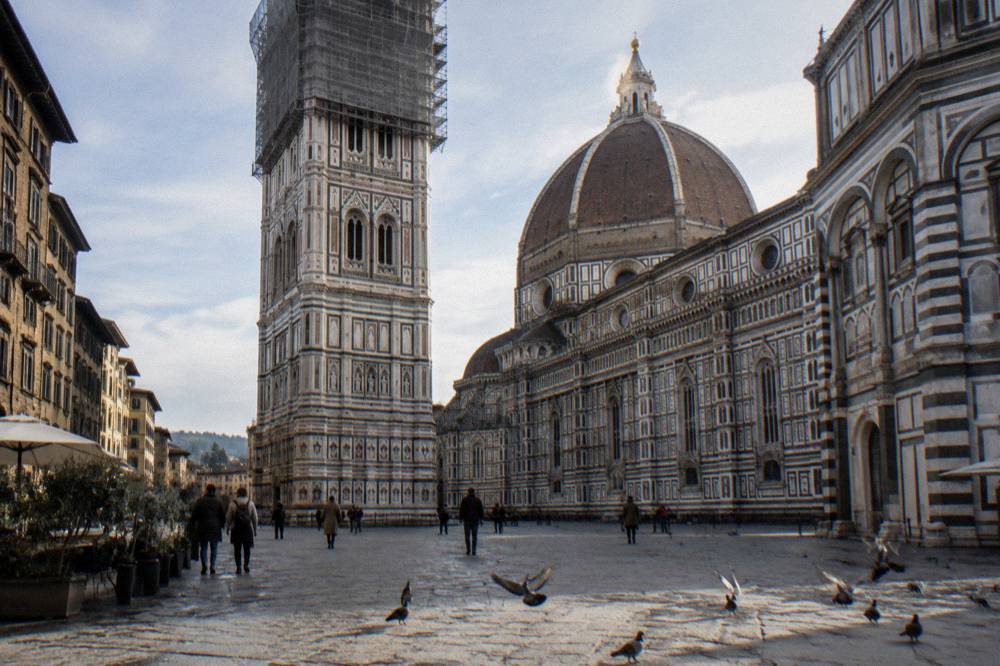
Yes. Giotto's Bell Tower stays open to visitors throughout its restoration, the first full restoration in the tower's history. The works began with about four months of scaffold assembly running to late July 2026, and the restoration itself is expected to take about four more years, with the Opera's project table setting out the works from 9 March 2026 toward 2030. Climbing still needs a Giotto or Brunelleschi Pass, with no timed reservation.
The Opera's construction-sites page is clear about what the bell tower restoration means for visitors: the tower stays open. The scaffold assembly phase, about four months to late July 2026, was the disruptive part, and the works that follow run about four more years, with the Opera's own table dating the project from 9 March 2026 and pointing to 2030 at a stated cost of more than 7 million EUR. The construction sites page carries the full statement.
The access rules do not change during the works. The tower needs a Giotto or Brunelleschi Pass, and no timed reservation is required to climb: the pass carries a three-day validity and you climb within it. That makes the tower the most flexible of the paid monuments, in contrast to the dome, where the timed slot is fixed to the first day of the pass.
| Project | Status | What it means for visitors |
|---|---|---|
| Giotto's Bell Tower restoration | First full restoration in its history, works toward 2030 | Tower stays open, pass needed as normal |
| Baptistery vault mosaics | Year three of a six-year restoration | Mosaics not visible from the ground |
| Baptistery access | Open, entered from the North Door | Ghiberti, Giotto or Brunelleschi Pass |
Anyone weighing a climb during the works is choosing between two knowns: the tower is open, and the restoration is visible around it. The Opera publishes the project on its own pages, and it does not describe the climb's view or its difficulty.
When Is The Quietest Time To Go Inside?
No official source publishes a quiet-time or crowd-pattern measure for the cathedral nave, so this guide does not state one. What the Opera di Santa Maria del Fiore does give is the window itself: Monday to Saturday, 10:15 to 15:45, with visitor access closed every Sunday and during religious celebrations. Within that window the nave is free and unticketed, so there is no timed entry to plan around.
The honest answer to this question is mostly a statement of what is not published. The Opera di Santa Maria del Fiore gives hours, closures and access rules; it does not publish visitor-density figures, quiet periods or a recommended time inside the day. The nave is free to enter without a ticket, Monday to Saturday from 10:15 to 15:45, and no published information says when it is emptiest.
What you can plan around is structure. The visiting window is fixed and narrow, five and a half hours a day, Monday to Saturday. Sunday removes sightseeing access entirely. Religious celebrations close the nave to visitors as they occur, and the Opera does not publish a forward calendar of them. The dress code and the bag ban apply at all hours, so the practical preparation is the same whenever you go.
The nave is one of the few indoor sights in Florence that is free to enter, so it draws visitors who would otherwise be pricing out museums. The Duomo's nave is free to enter, Monday to Saturday from 10:15 to 15:45. For the rest, the window is the plan: arrive inside 10:15 to 15:45 on a weekday, and the free entry takes care of itself.
| When | Nave access |
|---|---|
| Monday to Saturday, 10:15 to 15:45 | Open to visitors, free |
| Sunday | Closed to visitors |
| During religious celebrations | Closed to visitors |
| Any day, outside 10:15 to 15:45 | Not open to sightseers |
If your time in Florence is short and you would rather not budget hours to the complex alone, the free walks in the next section move through the neighbourhood with a local guide and cost nothing to reserve.
Which Free Walk Passes The Duomo?
Several free, pay what you want walks meet in the streets around the Duomo, and this site lists 24 in total, 22 on GuruWalk and 2 on freetour.com. The Duomo to Santa Croce Route Walk meets at Piazza di Santa Maria Novella on freetour.com, rated 9.1 out of 10 across 3,361 reviews. Dante, the Inventor of Hell meets at Piazza della Repubblica on GuruWalk, rated 4.32 out of 5 across 22 reviews.
Every walk on this site is free to reserve and pay what you want: you tip the guide at the end whatever the walk was worth to you, and the guides are independent locals listed on GuruWalk or freetour.com. This site operates no walk and takes no booking; it is a directory pointing at each walk's own page, which is why GuruWalk or freetour.com is named every time.
The Trilingual Renaissance and Medici Walk is one of the GuruWalk listings that meets near the complex: Piazza San Lorenzo, 2 hours, in English, Spanish and Italian, rated 4.88 out of 5 across 7,774 GuruWalk reviews. Its page on this site carries the meeting point and the full figures.
Dante, the Inventor of Hell takes a narrower historical angle: it meets at Piazza della Repubblica, runs 2 hours in English and Italian, and is rated 4.32 out of 5 across 22 GuruWalk reviews. The review pool is small, so read the rating with that in mind; 22 reviews is a genuine but modest base.
Other GuruWalk listings meet at Piazza San Lorenzo within the same neighbourhood, including the Essential Centre Walk, 2 hours in English and Spanish, rated 4.8 out of 5 across 20 GuruWalk reviews, and the Storyteller Walk, 2 hours 15 minutes in English and Spanish, rated 4.73 out of 5 across 1,872 GuruWalk reviews. Each has its own page on this site with its meeting point and figures.
| Walk | Platform | Meets at | Duration | Languages | Rating |
|---|---|---|---|---|---|
| Duomo to Santa Croce Route Walk | freetour.com | Piazza di Santa Maria Novella | 2 hours 30 minutes | English, Spanish and French | 9.1 out of 10 across 3,361 reviews |
| Trilingual Renaissance and Medici Walk | GuruWalk | Piazza San Lorenzo | 2 hours | English, Spanish and Italian | 4.88 out of 5 across 7,774 reviews |
| Dante, the Inventor of Hell | GuruWalk | Piazza della Repubblica | 2 hours | English and Italian | 4.32 out of 5 across 22 reviews |
| Essential Centre Walk | GuruWalk | Piazza San Lorenzo | 2 hours | English and Spanish | 4.8 out of 5 across 20 reviews |
| Storyteller Walk, 2 Hours 15 Minutes | GuruWalk | Piazza San Lorenzo | 2 hours 15 minutes | English and Spanish | 4.73 out of 5 across 1,872 reviews |
For planning the wider free day around the complex, the free walking tour guide sets out how the pay what you want model works, and the guide to Ponte Vecchio covers the next free landmark along the river. If you are timing a visit around the state museums' free days, the post on which Florence museums are free on the first Sunday lists the scheme, which does not include the Duomo complex: the Opera di Santa Maria del Fiore runs its own tickets and joins no national free-day scheme. The walk from the Duomo towards the other end of the historic centre ends near the basilica covered in the Santa Croce guide, which has its own separate free-day list. One of the free walks goes through this part of the city: Duomo To Santa Croce Route Walk.
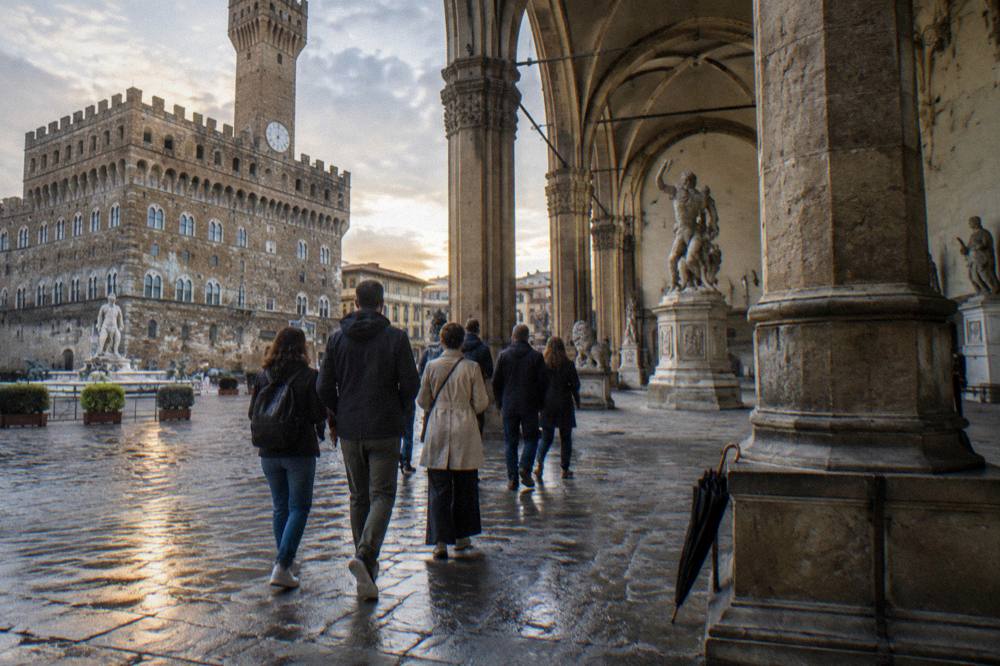
Whichever walk you choose, the free nave keeps its own hours and its own rules, and the passes keep theirs. The walks below all meet in the neighbourhood and are free to reserve.
Common Questions About The Duomo Florence
Is The Duomo Free To Enter?
Yes. The cathedral nave is free, with no ticket and no reservation, Monday to Saturday from 10:15 to 15:45. It is closed to visitors every Sunday and during religious celebrations, a dress code applies, and luggage and bags are not allowed.
Which Parts Of The Duomo Complex Need A Pass?
The dome, the bell tower, the baptistery, the crypt of Santa Reparata and the Museo dell'Opera del Duomo. The dome takes the Brunelleschi Pass with a timed reservation on the pass's first day; the bell tower takes a Giotto or Brunelleschi Pass with no timed reservation; the baptistery, crypt and museum take a Ghiberti, Giotto or Brunelleschi Pass.
Why Are The Baptistery Mosaics Hidden Right Now?
The vault mosaics are in year three of a six-year restoration, the first full restoration in over a century, and they are not visible from the ground during the works. The baptistery itself stays open, entered from the North Door with a pass.
Is The Bell Tower Open While It Is Being Restored?
Yes. Giotto's Bell Tower stays open to visitors throughout the first full restoration in its history, with works listed from 9 March 2026 toward 2030. A Giotto or Brunelleschi Pass is needed to climb, with no timed reservation.
When Is The Quietest Time To Go Inside?
No official source publishes a quiet-time or crowd measure for the nave, so no quiet time can be stated. The visiting window is Monday to Saturday, 10:15 to 15:45, with visitor access closed every Sunday and during religious celebrations.
Which Free Walk Passes The Duomo?
Several. The Duomo to Santa Croce Route Walk meets at Piazza di Santa Maria Novella on freetour.com; the Trilingual Renaissance and Medici Walk and the Essential Centre Walk meet at Piazza San Lorenzo on GuruWalk; Dante, the Inventor of Hell meets at Piazza della Repubblica on GuruWalk. All are free to reserve and pay what you want.